
Start a Mountain House People Search
Choose the official record that accepts the fact in hand. The San Joaquin County Recorder index is the best first stop for a person name tied to a deed, lien, mortgage, map, or other recorded paper. The Assessor and Treasurer-Tax Collector tools work in the other direction. They accept a street address, assessment number, or parcel number and can connect a place to assessment and tax details. The Superior Court offers a party-name search for cases. City records add staff, permits, agendas, and municipal business created since incorporation.
Phone numbers do not have their own government index. A number may appear in a staff listing, licensed-business filing, permit contact, old telephone book, or public case file, but the number alone may not be searchable. Names also change and can be entered in several ways. Search spelling variants, middle names, and prior surnames before deciding that no record exists.
- Use a name in the recorder index, court party search, city directory, or professional-license lookup.
- Use an address in the assessor and property-tax tools to identify the parcel and lien-date owner.
- Carry the parcel or owner name into the deed index to trace recorded transfers and related documents.
- For a deceased person or past resident, check obituary cards, marriage indexes, yearbooks, and historic directories.
- Ask the city, county, court, library, or archive for records that the public portal does not show.
Mountain House Records Changed in 2024
Mountain House became California's 483rd incorporated city in July 2024. That date changes where a researcher should ask. The City Clerk now keeps City Council agendas and minutes, the municipal code, city election material, and requests for records held by city departments. Files from before incorporation may remain with San Joaquin County, the former Mountain House Community Services District, or another service district.
This divide does not move core county records into City Hall. Deeds, parcel assessments, property taxes, county vital records, Superior Court cases, jail bookings, and county election administration still belong to San Joaquin County offices. The Mountain House public-records page directs requesters to email the City Clerk, describe the desired files, and give contact information.
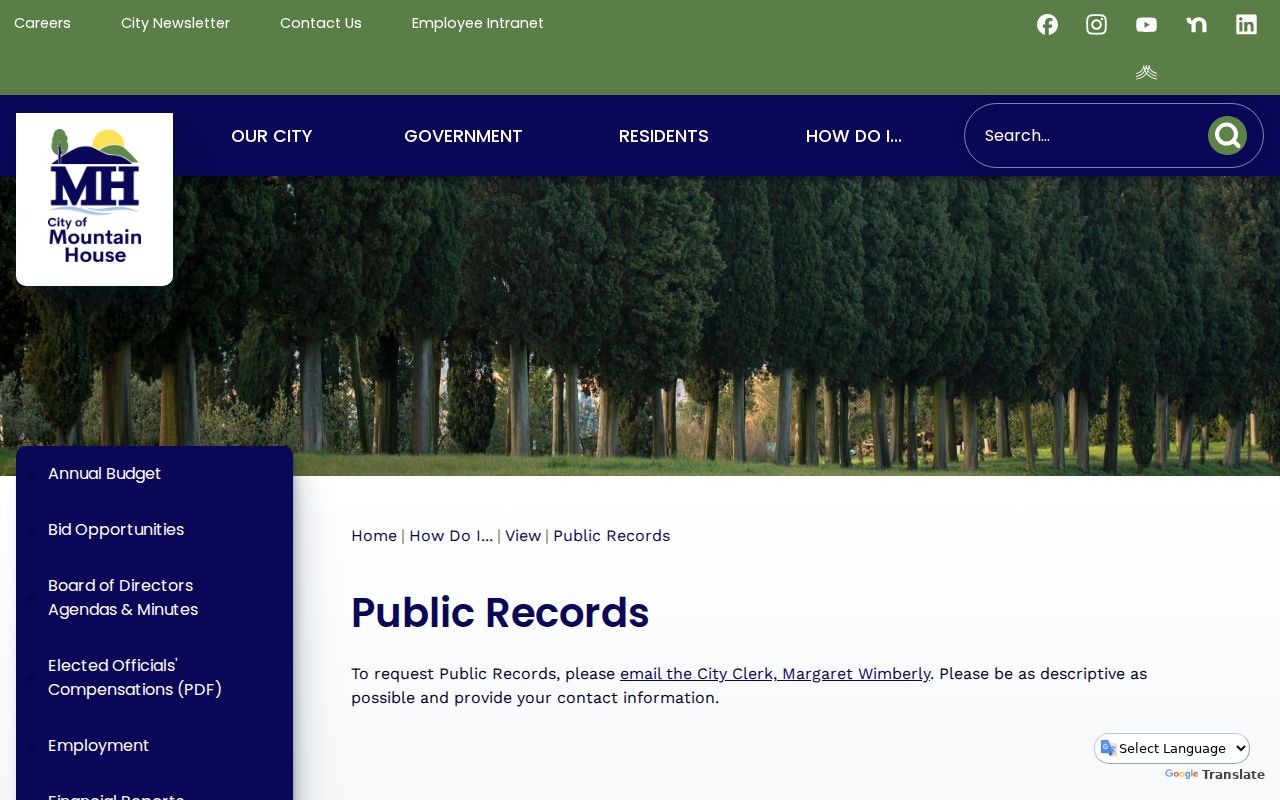
The city page confirms the direct request route for municipal material. A date, address, permit number, department, and narrow subject can help staff identify a responsive file.
Note: For a record created before July 2024, identify the former district or county custodian before sending a city request.
Offices Behind Mountain House Records
Most Mountain House people-search records are kept at county counters in Stockton. The Recorder maintains official documents and maps. The County Clerk handles marriage material, notary oaths, professional registrations, and fictitious business names. The Assessor and tax office connect parcels with assessment and billing records. City Hall is the right route for Mountain House municipal files. Detailed fees and request rules appear with the Mountain House public records system.
San Joaquin Recorder
44 N. San Joaquin Street, Suite 260
Stockton, CA 95202
209-468-3939
Recorded Documents and Maps
Recorder-County Clerk
44 N. San Joaquin Street, Suite 260
Stockton, CA 95202
County vital and clerk records
Mountain House City Clerk
251 E. Main Street
Mountain House, CA 95391
209-831-5039
Do not ask one office for another custodian's file. A city permit belongs with the city. A deed belongs with the Recorder. A court case belongs with Superior Court Records Management. This simple split saves time and keeps a request narrow.
Mountain House Deed Index Limits
The San Joaquin Recorder holds recorded documents and maps back to 1851, but its online Grantor/Grantee Index begins January 1, 1968. A grantor is a person or entity giving an interest in property. A grantee receives that interest. The online index acts like a catalog that points to recorded papers; it is not the document itself and should not be treated as proof of every fact within the underlying record.
The Tyler Self-Service recorder entry requires a reCAPTCHA before the acceptance button becomes active. Search all plausible spellings. The county warns that index data can change and recommends checking name variants. The only fields verified before the captcha are the disclaimer response and acceptance control, so later fields should not be assumed.
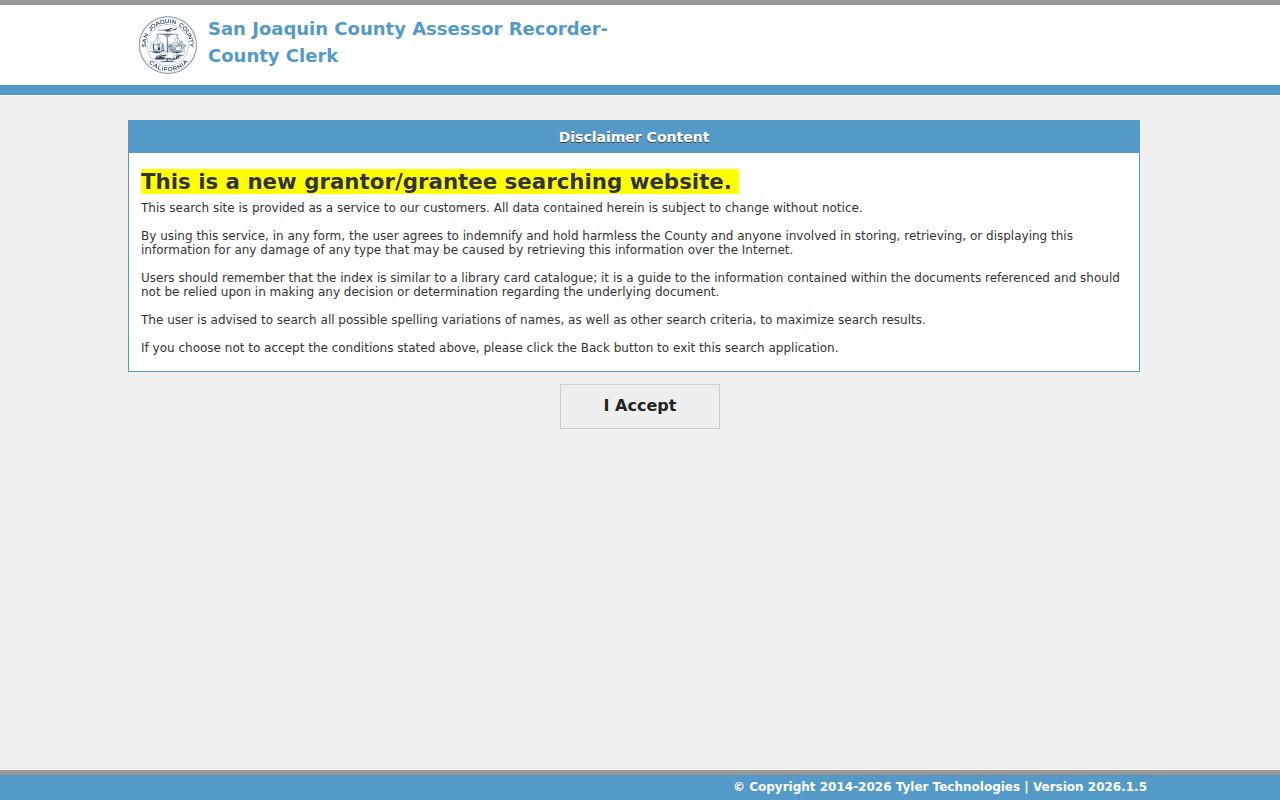
The screen shows why an online attempt may stop before a name search begins. Older deeds and any item needing close review can be viewed digitally or on film at the Recorder's Stockton office.
The county coverage page explains the longer office history and its copy route.
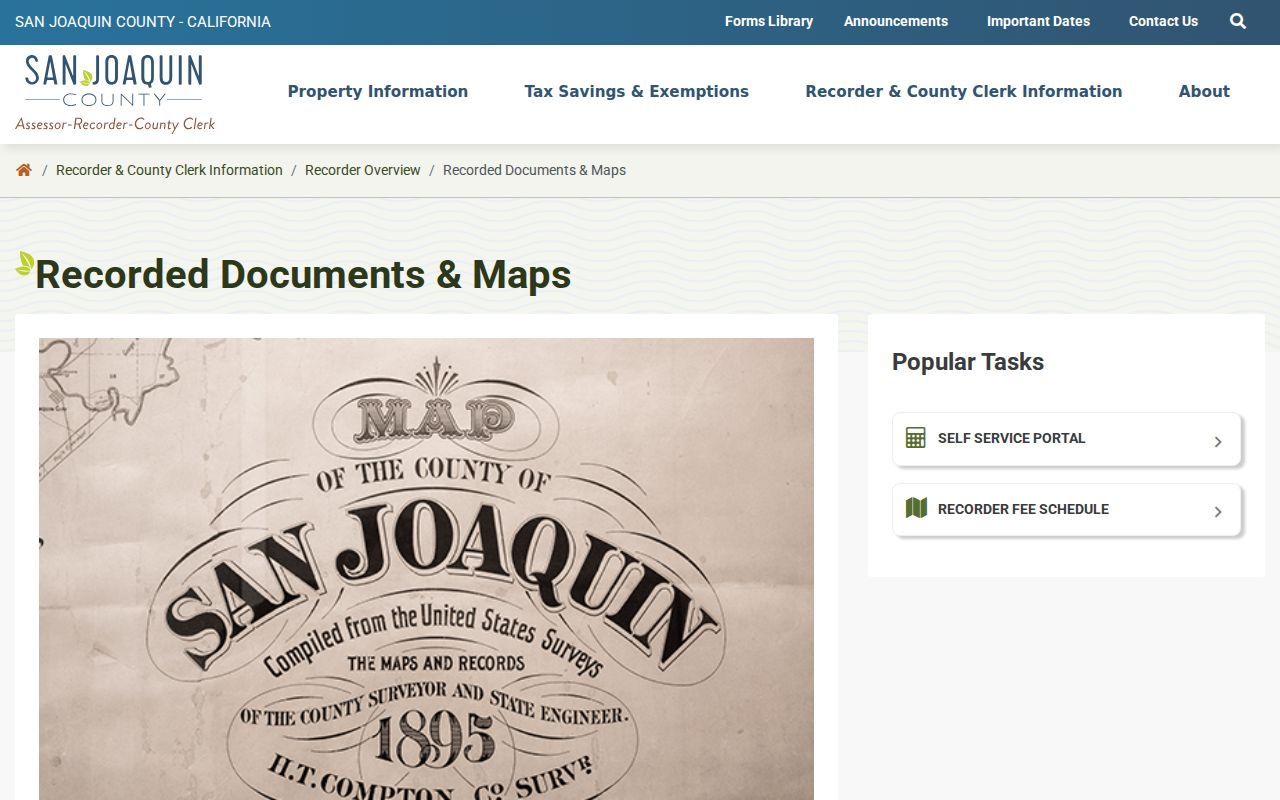
That distinction matters for family history and old land research: online coverage is shorter than the Recorder's full collection.
- Index
- A finding tool that points to a recorded document.
- Grantor
- The party transferring or giving an interest.
- Grantee
- The party receiving that interest.
- Certified copy
- A copy authenticated by the official custodian.
Trace Mountain House Property Records
Mountain House property research works best as a chain: street address to parcel, parcel to tax account, owner name to recorder index, then deed to earlier owners. The official Assessor form does not offer an owner-name search. It accepts Fee Parcel, Assessment, Street Address, Boat, CF#, Aircraft, or Tail#. Entries must meet the portal's length limits. A fee parcel search is broader than a single assessment search when more than one outstanding assessment may exist.
The San Joaquin Assessor property lookup displays the real search choices.
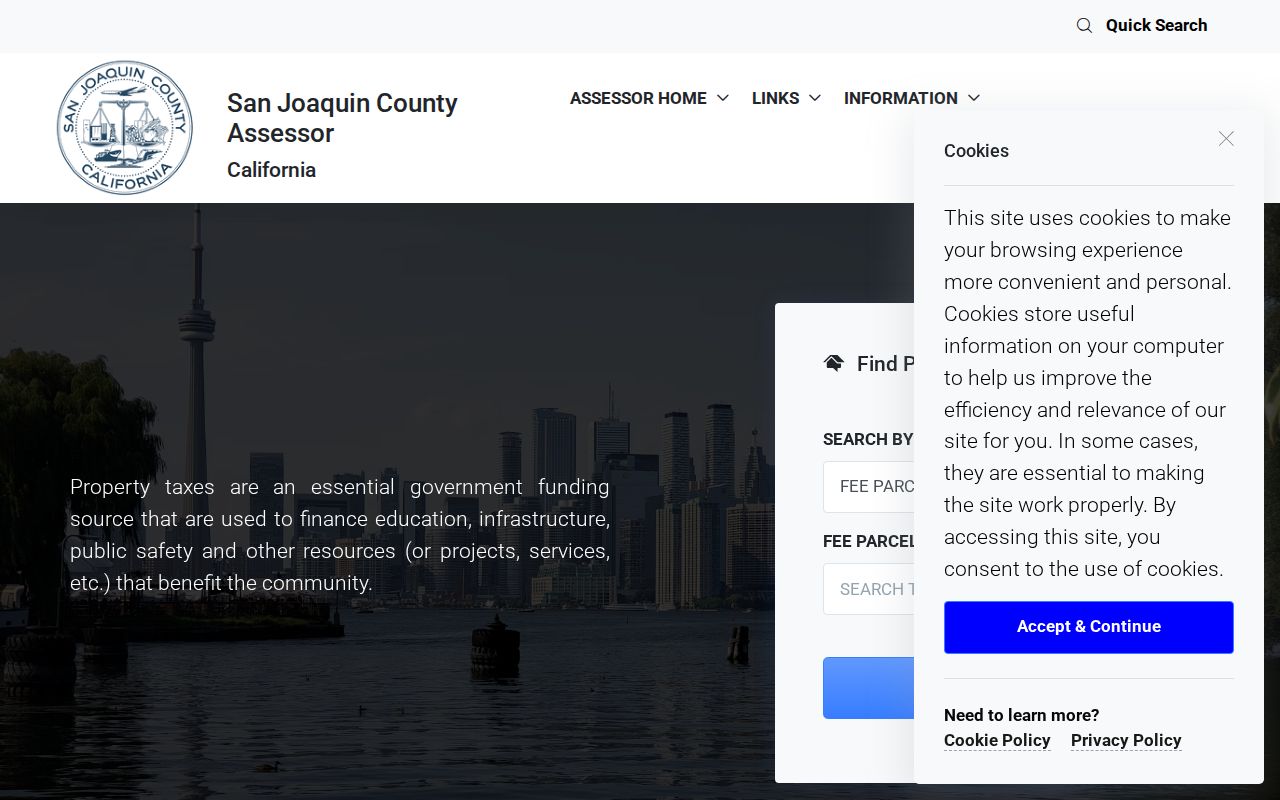
The screenshot confirms that a surname alone cannot be entered in this form. When only a name is known, begin with the recorder, a license directory, or another name-based source.
| Known fact | First official tool | Useful result | Next step |
|---|---|---|---|
| Street address | Assessor lookup | Parcel or assessment link | Open tax and deed records |
| Parcel number | Tax search | Roll year and bill details | Check lien-date owner |
| Owner surname | Recorder index | Recorded-document trail | Request the document |
| District question | County GIS | School, district, or map context | Confirm with the record keeper |
Mountain House Tax and GIS Clues
The Treasurer-Tax Collector search adds roll-year context. Its options cover years shown from 2019 through 2026 and accept a fee parcel, assessment, or street address. The sample bill labels the assessment number, parcel number, physical location, lien-date owner, tax-rate area, and mailing-address area. A mailing address can differ from the property's situs, which means its physical location.
See the choices on the property-tax search.
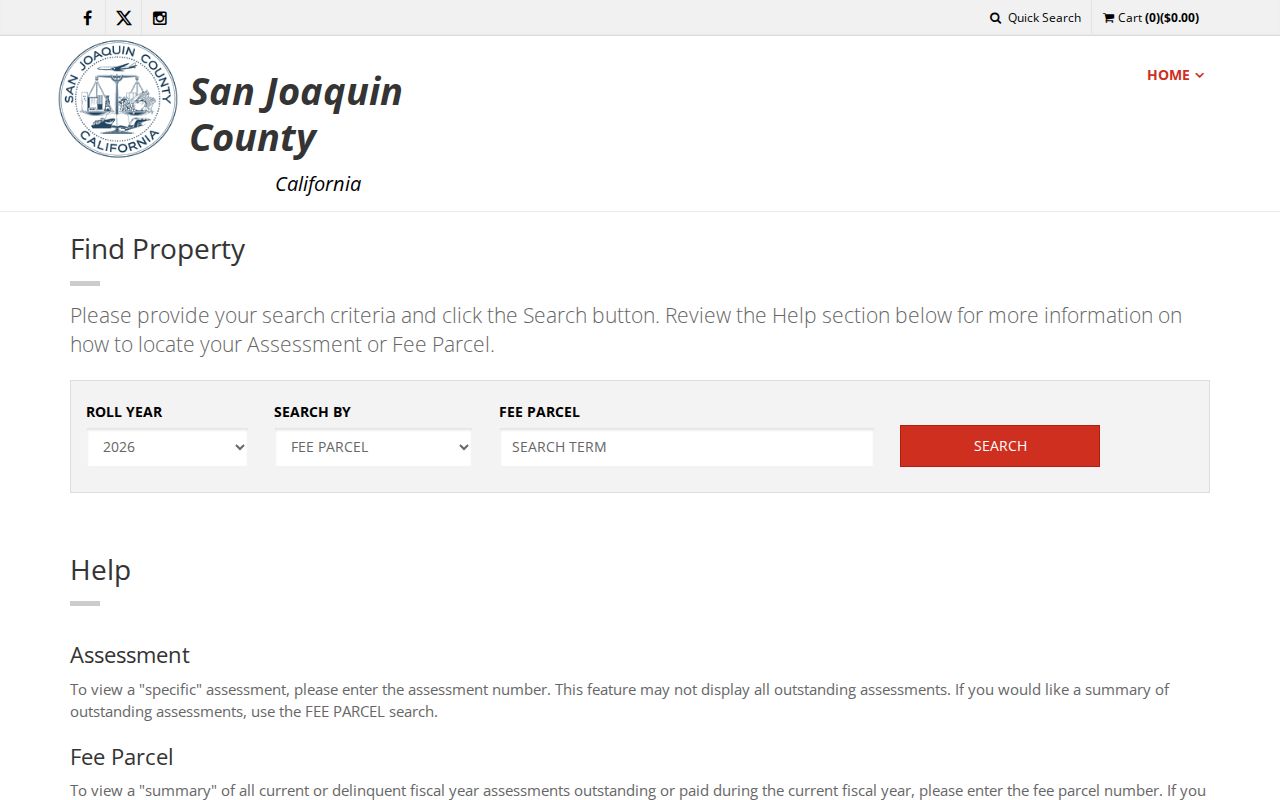
Roll year and search mode help separate a current bill from an older assessment trail.
The San Joaquin GIS Map Server supplies district, school, assessment-map, survey, and flood tools.
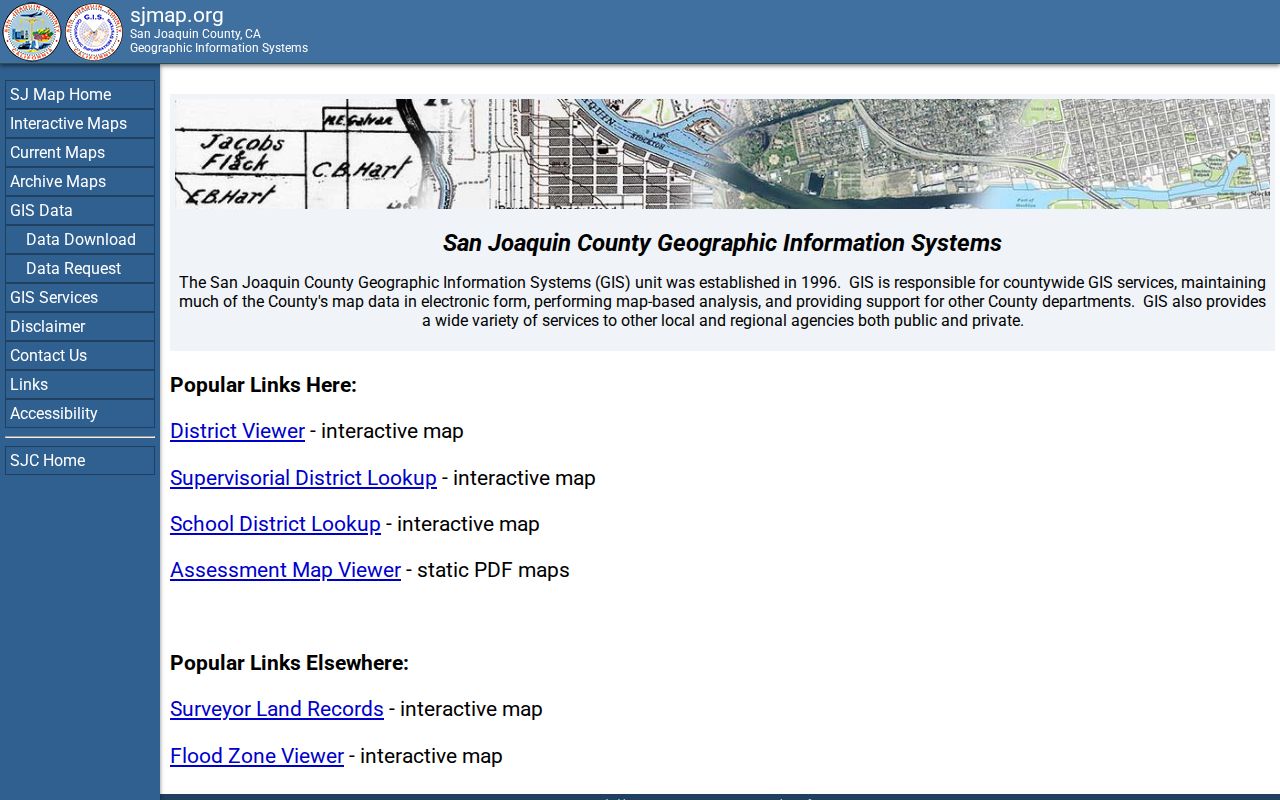
GIS adds place context, but it does not replace a deed or assessment record. The assessment viewer itself warns against using its maps as legal ownership proof.
The Assessment Map Viewer notice states that limit.
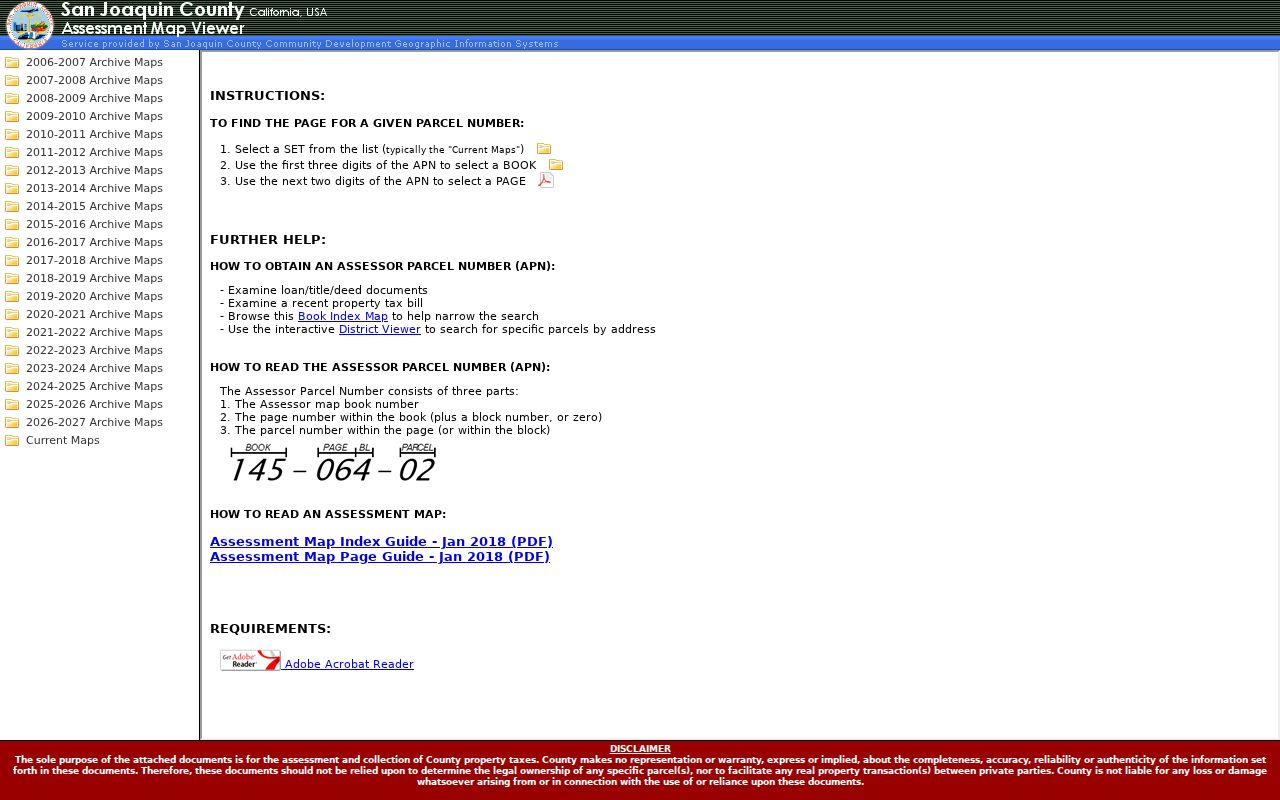
Use the map to identify a parcel, then confirm names and ownership through the Assessor and Recorder.
Search Mountain House Court Records
San Joaquin County Superior Court is the local trial court for Mountain House. Its work includes civil, criminal, small claims, traffic, probate, family, juvenile, and mental-health matters. The online Case Management Search offers separate routes by party name and case number. Under California Rule of Court 2.507, a public party search is limited to first, middle, and last names. Date of birth and driver's license data cannot be used to refine that public search.
The case-management search page explains those name limits.
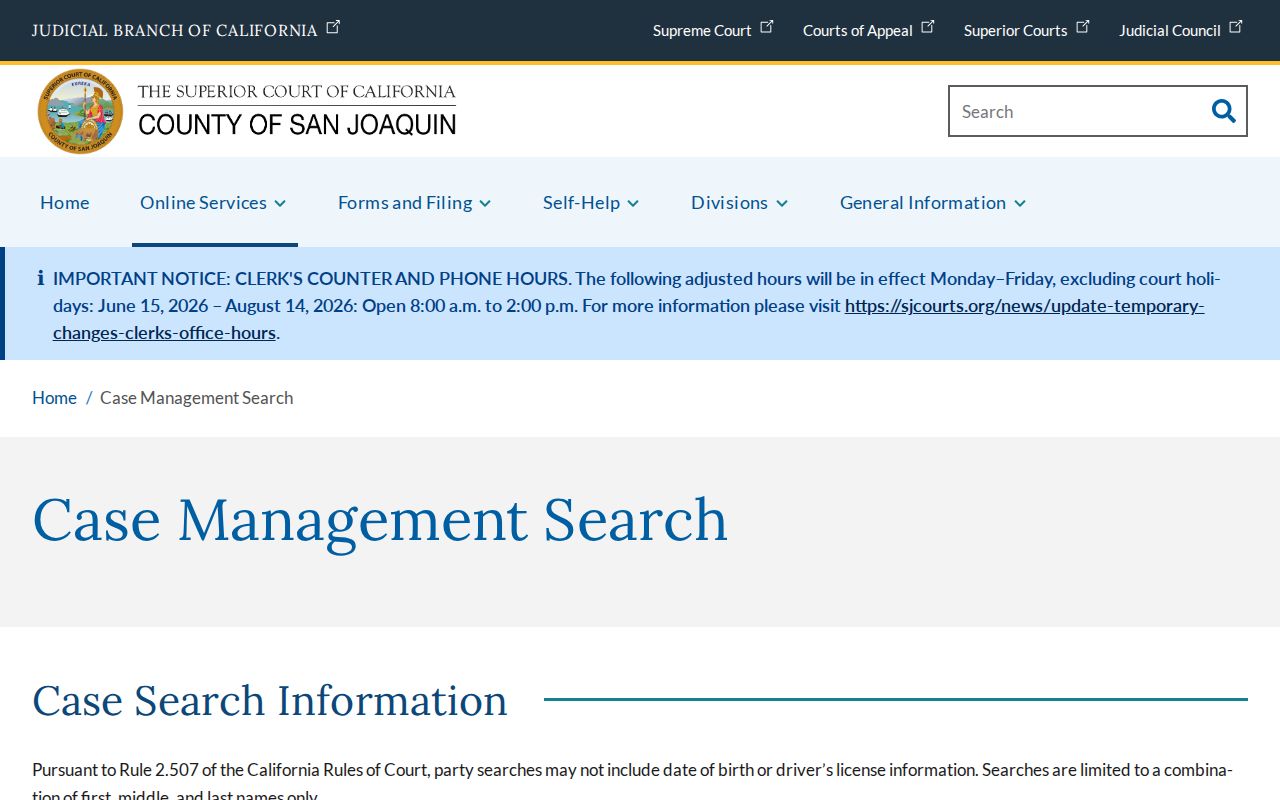
The name search identifies possible cases. It does not create a criminal-history report, and a matching name should not be treated as proof about a person without reviewing the public file.
| Court source | Search route | What may require offline access |
|---|---|---|
| Case Management Search | First, middle, and last name | Details withheld under Rule 2.507 |
| Public Access Portal | Case number and public calendar | Older criminal registers of actions |
| Records Management | Known case number and request card | Archived files, copies, and certifications |
| Eastern District of California | PACER federal case search | Federal filings and dockets |
When Mountain House Court Search Stops
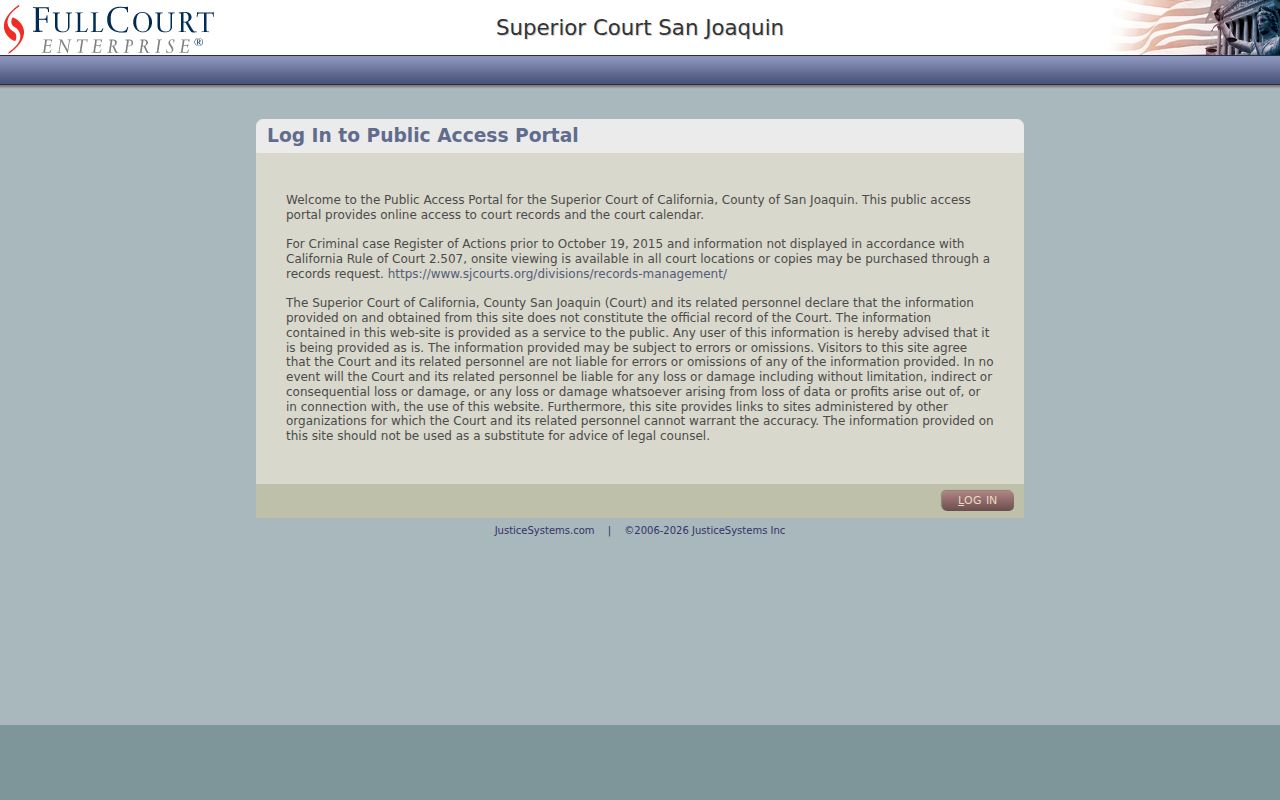
The web portal does not show every accessible court record. Criminal registers of actions from before October 19, 2015 are not available through the public portal, and sealed or otherwise restricted material remains closed. Records Management keeps archived public court records dating to 1850, though destruction schedules mean that not every old file survives.
The Superior Court Public Access Portal displays the older-record warning.
If the case number is unknown, use a public terminal at the Stockton Main Courthouse or ask the clerk to research the name. The court posts a $15 research charge when a name search takes more than ten minutes. Copies are available by walk-in, appointment, or mail, but not by email. A mail request needs the form, payment, and a self-addressed stamped envelope.
Lawful use. A court-name match can involve another person with the same name. Verify the public file and never use record information to stalk, harass, or threaten anyone.
Order Mountain House Vital Records
San Joaquin County Recorder-County Clerk keeps county birth, death, and marriage records from 1851 to the present. California does not display certificate images online. Health and Safety Code section 103526 limits authorized birth and death copies to listed people. Others generally receive a certified informational copy marked as invalid for establishing identity. A public marriage license is a public record, but access to an identity-valid certified copy is still limited.
For a Mountain House event, start with the county. CDPH Vital Records is the statewide route. A confidential marriage certificate comes only from the county clerk that issued the license and only to the two people named. Divorce decrees come from Superior Court. Historical alternatives include the county library obituary-card index for 1850 to 1991, a FamilySearch marriage index for 1850 to 1900, and Historical Society vital and marriage holdings.
| Record | Primary keeper | Access point | Known fee |
|---|---|---|---|
| Birth | County Recorder-Clerk or CDPH | Authorized or informational copy | Check current application |
| Death | County Recorder-Clerk | Mail or county application path | $26 |
| Public marriage | County Recorder-Clerk | County certificate request | $19 |
| Divorce decree | Superior Court | Court copy request | $15 certified judgment |
Mountain House Permit Trails
Permit files have special value in a city still being built. Mountain House planning data reported 9,045 residential permits issued, 8,467 finaled, and 7,755 primary units not yet permitted as of April 1, 2025. That active buildout means an address may connect to recent applications, site plans, inspections, contractors, engineers, and contact names, subject to redaction and public-record exemptions.
The city Building Division routes permit submissions through GreenVue or accepts them in person. Inspection scheduling uses a permit number, property address, inspection type, preferred date and time period, contact name and phone, plus access notes. The official page did not expose a verified public permit-search form, so request a public permit file from the city when it is not visible online.
Property evidence should be read in layers. The permit shows work proposed or inspected. The assessor identifies the parcel. The tax bill can identify a lien-date owner. The Recorder supplies the recorded transfer trail. No single layer answers every question about an occupant or owner.
Find Past Mountain House Residents
The modern community is much newer than San Joaquin County's historical collections, so older Mountain House people searches often need countywide sources. The San Joaquin County Historical Society holds official county archives from 1850 to 1990, city and county directories from 1852 to 1980, assessment and plat books, vital statistics, marriage material, maps, photos, and the Great Registry of Voters.
The Stockton-San Joaquin County Public Library collects local city directories, telephone books, and high school yearbooks. Its genealogy resources include in-library Ancestry Library Edition, HeritageHub newspapers, and the San Joaquin County Public Library Obituary Index. FamilySearch offers the obituary index for 1850 to 1991 with searches by first name, last name, birthplace, and birth year, plus browsable images.
Begin with an obituary for a deceased person, then use marriage records for a spouse or former surname. Directories and telephone books can tie an adult to an address. Assessment books and deeds can follow a household move. The Great Registry supplies a historical voting and residence trail without treating the modern restricted voter file as an open directory.
Mountain House Voter Record Limits
California voter registration data is not a public people-search roll. A person may use My Voter Status to check personal registration, while access to voter-file data requires a qualified election, scholarly, journalistic, political, or governmental purpose. The file can include a voter name, birth date, registration date, residential and mailing address, precinct, contact information, party preference, and requested participation or district data.
Protected items are excluded. They include driver's license and state ID numbers, the last four Social Security digits, the unique voter identifier, signatures, confidential-voter records, and preregistration data for minors. Participation history shows that a ballot was cast and by which method, never the voter's choices. The full eligibility, fee, and security rules belong with the Mountain House voter registration lookup.
Note: A voter-file request must state a permitted purpose; curiosity or commercial use does not qualify under California law.
Statewide Mountain House Name Lookups
Some useful name searches are held at the state level. California DCA License Search covers professions regulated by its boards. The Contractors State License Board accepts a license number, business name, personal name, or salesperson registration. The State Bar accepts an attorney name or bar number. SOS bizfile exposes business entities, agents, addresses, filings, and PDFs, while its UCC search supports debtor, secured-party, and file-number research.
California Unclaimed Property is another name-and-address trail. The State Controller says there is no fee and no deadline to claim property. That fact is also a scam check when a private sender asks for a large advance payment. Custody searches are separate: the San Joaquin Sheriff provides Who is in Custody, CDCR maintains CIRIS for state custody, and the federal Bureau of Prisons locator covers federal inmates from 1982 forward.
Each source has a narrow purpose. A license entry can verify status and board data. A business filing can link an entity and agent. An unclaimed-property result is not proof that a person still lives at the shown address. A jail roster reports custody status, not conviction, and the county warns against harassment or legal reliance.
Privacy in Mountain House Searches
Official records may omit or redact details for safety and privacy. California Safe at Home, under Government Code section 6205 and following sections, provides a substitute mailing address for qualified participants. Separate election statutes protect confidential voters. Vital-record law controls who can receive identity-valid copies, and court rules limit personal data in public name searches.
California consumer privacy rights can apply to covered commercial data businesses, including rights to know, delete, correct, opt out of sale or sharing, and limit certain sensitive uses. Publicly available government records are excluded from the California Consumer Privacy Act's definition of personal information. Removing a broker listing therefore does not erase a deed, license, court file, or assessment held by its public custodian.
Use the least intrusive record that answers the question. Confirm names through more than one official source, respect protected addresses, and stop when a record is sealed or restricted. Public access does not grant permission to intimidate, follow, or harm a person.