
Checking Mountain House Voter Registration
The official starting point for a Mountain House resident is the California Secretary of State's My Voter Status service. It is designed for a voter to check personal registration status and the county of registration. It is not a public directory that lets a visitor browse everyone registered in Mountain House. During research, the status page returned a bot-management frame, so its live form labels and required fields could not be verified. No names, dates of birth, counties, or ZIP codes should be assumed to be lookup fields without seeing the live form. The captured official source below documents the access barrier that can appear before the form loads.
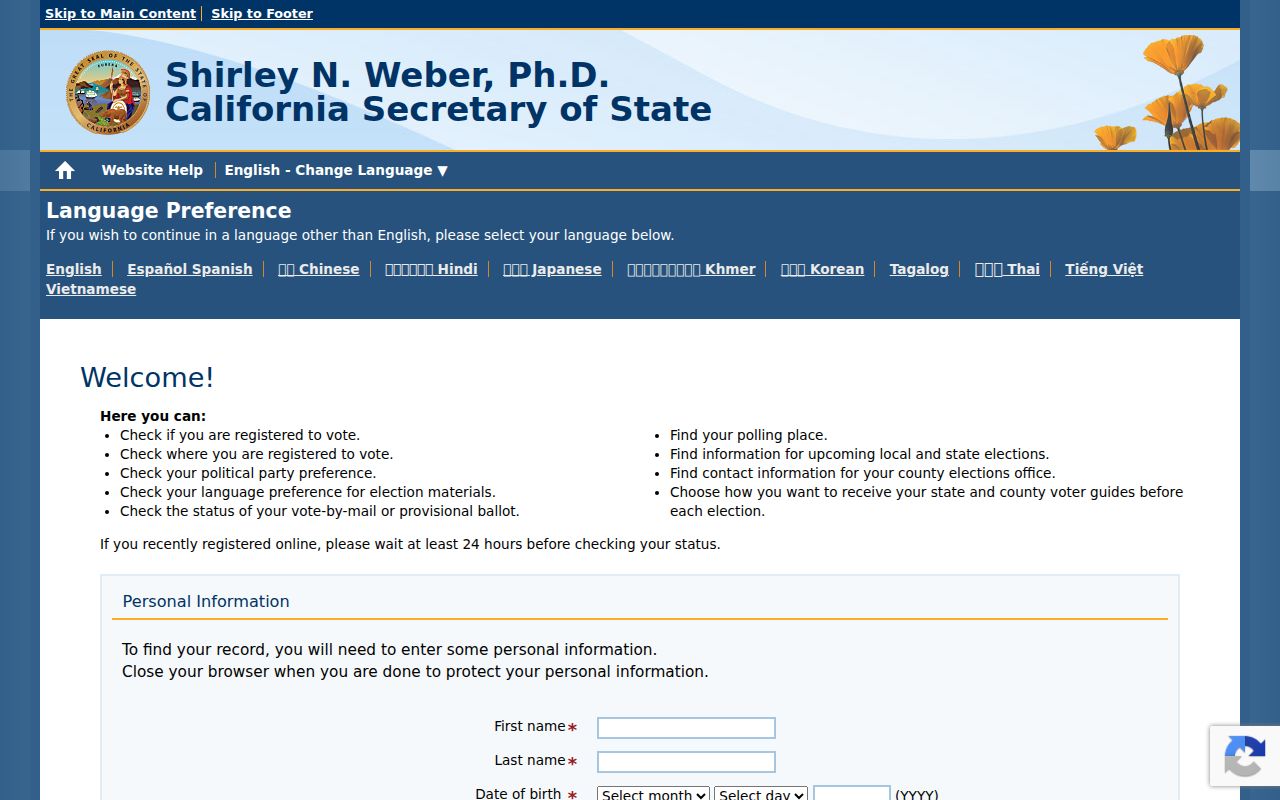
A blocked frame does not turn the tool into a general voter roll search. Use a normal browser, then contact San Joaquin County election staff if the official status service still does not load.
| Verified lookup item | Type | Required | What the research established |
|---|---|---|---|
| My Voter Status form fields | Unknown | Unknown | The official interface was hidden by bot management; no lookup field labels were visible. |
| Online registration prerequisites | Information, not status-search fields | For online registration | California lists a driver license or state ID number, last four Social Security digits, and date of birth; voters without state ID may need extra steps. |
A sound Mountain House status lookup uses the narrow official path and keeps the registration application separate.
- Open My Voter Status in a standard browser and allow the official page to load.
- Review only your own status. Do not treat the tool as a browseable voter roll.
- Contact San Joaquin County election staff if the service fails or the record needs correction.
Registration prerequisites belong to the separate California online registration application. They are not proof that the status lookup asks for the same items.
Mountain House Status Lookup Limits
California voter data is a restricted record set. Elections Code sections 2188 and 2194 govern access, while the statewide VoteCal database stores the registration information. A Mountain House resident checking personal status is using a different channel from a researcher asking for a statewide, county, or single-voter data file. That distinction matters because the official status portal is not evidence that the voter file is open to anyone for any reason.
The San Joaquin County Registrar of Voters also offers current election tools, registration information, voter privacy material, historical county voter information guides, sample ballots, results, statements of votes cast, ballot tracking, and precinct or voting-location maps. Those public resources explain elections and help voters act on their own records. They do not expose the complete Mountain House registration list. When a status problem cannot be resolved online, the county office is the proper fallback.
Restricted, not openly searchable. California voter records require an approved statutory purpose and a completed request; the self-check portal is not a public people directory.
Mountain House Voter Record Contents
An approved voter file can be detailed, but its fields are organized across three plain-text, tab-delimited files. The main registration data file includes active voters automatically. Inactive voters must be specifically requested. A participation history file can be added, as can a political districts file that links precincts to districts. These are data extracts for authorized use, not screenshots of a ballot or a scan of a signed registration card.
| Voter Registration Data | Name, date of birth, registration date, residential and mailing address, precinct, contact information, political party preference, and requested status coverage. |
|---|---|
| Participation History | Election type, election date, and voting method, such as polling place, conditional registration, or vote by mail. |
| Political Districts | Precinct number plus the associated district number and district type. |
| Activity Status | Active voters are included by default; inactive Mountain House voters must be requested. |
| Ballot Choice | Never included. Participation means that a ballot was cast, not how the voter marked it. |
This inventory prevents a common error. Voting history is participation history only. It may show that a Mountain House voter took part in an election and the method used, but the secret ballot remains secret. The political districts file is also relational: it maps a precinct to district types and numbers rather than offering personal opinions or ballot selections.
Confidential Mountain House Voter Records
The public-purpose file has firm exclusions. California does not release a driver's license number, state identification card number, last four digits of a Social Security number, the statewide unique identifier, a signature, or a digitized signature image. Preregistration records for 16- and 17-year-olds are also excluded because those minors are not registered voters until age 18. These limits apply even when the requester otherwise qualifies.
Protected voter records receive added treatment. Elections Code sections 2166, 2166.5, 2166.7, and 2166.8 cover confidential registrations, while section 2166.9 addresses certain confidential contact information for elected officials and candidates. California's Safe at Home program under Government Code section 6205 and following can provide a substitute mailing address to qualifying participants. These safeguards are especially important when a disclosed residence could put someone at risk.
Confidential by California law. Identifiers, signatures, protected-voter records, and minor preregistrations stay out of the voter file under Elections Code sections 2166 through 2166.9 and 2194.
Note: Removing a field from a released file is a legal access limit, not proof that the source registration record lacks that field.
Mountain House Voter File Requests
The California Secretary of State handles statewide files and requests for up to ten named voters. San Joaquin County handles a county-specific file. The applicant must identify a permitted purpose and accept the security duties that come with the data. State applications are reviewed in the order received, and the published processing range is seven to fourteen business days. A complete form does not guarantee approval if the proposed use falls outside the statute.
| Request path | Scope | Published charge | Key requirement |
|---|---|---|---|
| Statewide file | All California voters, with optional history or district data | $100 application fee | Apply to the Secretary of State with a qualified purpose. |
| Single-voter records | Up to 10 named voters per application | $30 per record, capped at $100 | Give full name, date of birth, county of residence, and residence address for each person. |
| San Joaquin County file | Voters registered in the county | County fee varies | Request from the county elections official; optional history and districts may be available. |
| Confidential official or candidate contacts | Records covered by Elections Code section 2166.9 | $15 per 1,000 up to $100 statewide, or $30 each up to $100 | Qualified journalistic or governmental purpose; local requests go to the county. |
The practical steps are to choose the right scope, complete the official application, state the precise permitted use, select optional history or political district data if needed, and submit the published fee. For statewide help, the VoteCal Help Desk is available at 916-654-1141 or votecalhelp@sos.ca.gov. A Mountain House-only project will often be better scoped as a San Joaquin County request rather than a statewide file.
Mountain House Voter Help in Stockton
The San Joaquin County Registrar of Voters administers local election services for Mountain House. Registrar Olivia Hale's main office is at 44 North San Joaquin Street, Third Floor, Suite 350, Stockton, CA 95202. Mail goes to PO Box 810, Stockton, CA 95201. Call 209-468-VOTE (8683), toll free 800-400-5009, or the Spanish line at 209-953-1052. The fax number is 209-468-2889, and the office email is registrar@sjgov.org.
The county voter registration office page appears in the captured image below with its voter tools and service links.
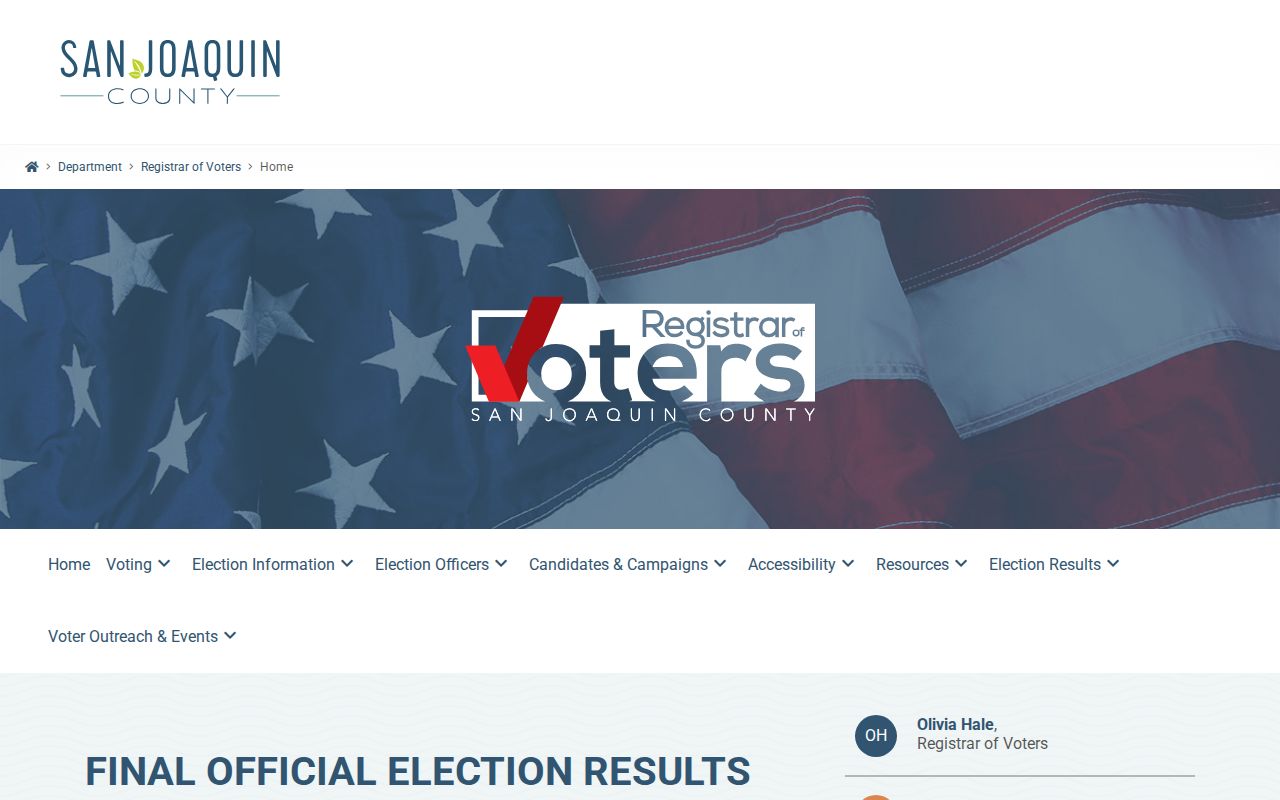
The office page is the local route for registration help, privacy questions, county data requests, and election resources when the state status portal does not answer the issue.
The county's current election resources include polling and drop-box locations, an interactive precinct map, congressional district lookup, ballot cancellation and cure forms, ballot tracking, observer guidance, and election testing or tally notices. These tools answer election-administration questions. They should not be confused with access to Mountain House voter records.
Qualified Mountain House Voter Data Uses
Eligibility turns on purpose, not mere curiosity. California permits candidates for federal, state, or local office to seek access. Committees supporting or opposing an initiative or referendum measure may qualify when legal publication has been made. Any person may apply for election, scholarly, journalistic, or political purposes. Governmental use may also qualify when the Secretary of State determines that it does. The phrase "any person" does not erase the purpose test.
A family-history project is not automatically a scholarly purpose, and an informal effort to find a current address is not automatically political or journalistic. The application must describe the real use, and officials decide whether it fits Elections Code sections 2188 and 2194 and the related regulations. California also bars commercial use of the voter file. General access-law concepts are covered separately in the Mountain House public records process, but the voter-file rules are the controlling limits for this data set.
Applicants also accept security duties. The released file can contain dates of birth, addresses, contact details, precinct data, and party preference. Approval is not permission to republish the data without limit or use it for a new, unstated aim.
Mountain House Voter Data Misuse
Voter registration data may not be used for harassment, stalking, threats, or an unapproved commercial purpose. The Secretary of State cites Elections Code section 18109(b), Business and Professions Code section 17538.41, and California Code of Regulations sections 19001 through 19004, 19006, and 19008 through 19013. Misstating the proposed purpose or shifting the data to a prohibited use can bring penalties and end access.
Keep approved files secure, limit access to people working on the stated project, and dispose of unneeded copies with care. Never treat an old address as a current fact without lawful confirmation. California stalking law at Penal Code section 646.9 and civil harassment remedies can apply when records are used to follow, threaten, or harass a person. Public-interest access and personal safety must operate together.
Note: A qualified request grants narrow data access for the approved task; it does not grant a right to contact or target a voter.
Active and Inactive Mountain House Voters
The statewide registration file includes active voters by default. Inactive voter records must be requested. That request choice affects the scope of a Mountain House data extract and should be made before ordering, especially in work that studies turnout, district change, or past registration patterns. The research did not establish a public Mountain House cancellation-status browser, so no one should infer more detailed status categories from the self-service portal.
Participation data is optional and separate from the core registration file. It records whether a person cast a ballot, the election and date, and a voting method such as polling place, vote by mail, or conditional registration. It never reports the selections made. County voter guides and statements of votes cast describe elections at a broader level, but they are not substitutes for an approved person-level file.
Historical Mountain House Voter Registers
Modern restrictions do not erase the value of older election sources. The San Joaquin County Historical Society and Museum archives hold the Great Registry of Voters for San Joaquin County. The same institution holds official county archives from 1850 through 1990, assessment and plat books, vital statistics, marriage records, and city or county directories spanning 1852 through 1980. Together, those sources can place an adult resident in a historic community without treating the current voter file as an open roll.
Mountain House adds a local timing issue. The city incorporated in July 2024, while the county's record systems and historic place name are much older. A historical voter may be indexed under San Joaquin County rather than a City of Mountain House system. County historical voter information guides can add precinct and election context, but they are not voter lists. For family history, compare the Great Registry entry with directories, property books, marriage material, and obituary sources before concluding that two similar names refer to the same person.
This archive path is the strongest historical alternative when a lawful project concerns older residents. It also shows why present-day voter registration access rules should not be bypassed in the name of genealogy.